Friday, January 28, 2011

Modulation takes time...

So as promised by the few that are following here is an update of the project I've been working on for the last couple of evenings.

I'm working on the modular building blocks to import into the engines of all engines, the UDK. Since brushing the cobwebs that had formed on the Maya icon on my desktop I realised that I was actually half decent at modelling. As Scott reminded me, I had downloaded the wrong version. And every icon had switched functions. And there was no multilister. And I couldn't unload the files onto someone for help. And there was also a funny humming noise emitting from my machine every time I clicked an button named 'Boolean'. But putting all the small issues aside, I came up with 16 reusable assets that could be quickly duplicated around an Unreal level to create variations of buildings.

The process was pretty straight forward, I started off by changing the grides lines in Photoshop to match the grid spacing in the UDK, this meant that every square in PS represented 1 grid space in UDK (using the standard 32unit measure). I decided what assets I wanted and went on the hunt for some nice photo references. Now, I'm no texture artist and nor do I have even the smallest amount of patience for texturing, however, I came up with some pretty interesting looking assets adding bits of grime and rust where I thought necessary. Afterall, the majority of how the texture will look will use the Material editor of the UDK.


I then went into Maya and changed the grid spacing again to UDK units using a tutorial on WoLD. I then created a plane that was 1024x1024 so that I would fit perfectly the texture I had created in PS. It was then just a case of extruding off the plane and creating the individual assets UV'ing where necessarly. I also changed the pivot points to the bottom left of the asset so that they could be easily duplicated in Unreal (Thats what the Epic guys do) and also create a separate UV channel to hold lightmap information and then exported!


That's my progress is as it stands. If anyone wants any links to the tutorials that have been guiding me on this emotional journey I can link you. Once in Unreal I'm hoping to add effects in the two window assets so that I have different coloured lighting, maybe a few blues and reds so that it breaks up the repetition a bit. I also want to mask out areas of the wall and other assets where I can add a snow overly to give the scene a nice cold atmosphere. All of this is theory for now and will probably result in a warm sunny beach in Fiji.

Thursday, January 27, 2011

Does anyone else know why the word 'blog' is an incorrect spelling on such sites?

After finishing my MA I got a sense on unease. So what am I supposed to do now? Make games, I guess. So this is what I am going to do. Be the best designer and work on the best titles. Theoretically.

I want to continue my blog (not that it had much of a start) as a way to force me to carry on designing in the dry periods. I have a lot of ideas up my sleeve and as a way of keeping me motivated and driven I will be posting progress on each of these projects. The only thing I hate most is letting people down, so if you feel let down by my progress, give me a boot in the right direction!

I also want to continue this blog because I know a few of the other EX MA students are continuing with theirs, I think it will be a great way to stay in touch as we had one talented bunch of nOObs (sp?) if I don't say so myself! I wish everyone the greatest of success on that note.

Back to me..

The first plan of action is to find the right job for me. I want to be a designer, not tester or a coffee maker. A real life games designer. I've applied at the companies I have a true passion to work at, and if they don't reply, damn them, and i'll continue down the list, we'll see where I end up!

As far as personal projects go, I'm hoping to develop my own UT3 Deathmatch game. I want to do this for a number of reasons, firstly I believe every level designer should understand what makes a Deathmatch arena truly great. You have to think about flow, holding the player up without blocking them, vantage points and danger points throwing in a few choke points for good measure. Im unsure whether im using UT3 or UDK for that but will probably use existing Unreal assets.

I've also opened up Maya again for the first time in God knows and with my trusty friend Scott 'BST' Taylor I'm learning and modelling again. Im creating modular building assets that can be duplicated around levels to quickly errect full scale buildings, I'm making good progress and when I hit any walls the Taylor Bros. are there to smash them down with bear like ferocity.

I'm also (might be) working on a UDK Mod with Ste 'pie finger' Thornton, Kalie 'asleep in the toilet' Walker and Paul 'big gunz' Bannon. If this goes through I think it will be truly interesting and push my skills out of my comfort zone. With my UDK skills along with Ste's ingenious game designs and Kalie and Paul's truely awesome art and modelling I think we could make a good go at a game representing UCLAN graduates at the same time.

I thought I would run out of things to say after the first quick whip at self reflection but the bottled words escaped. Hopefully this will be the new start of many.

Friday, November 5, 2010

Been some places and seen some things

I have been working on a lot since my previous blog post on the Alien Level which was created as part of a LARP event for Jim. At the time i wasn't satisfied with the results, it was a buggy, non flowing cluster of static meshes which I named a level design. For me now I can not believe some of the obvious mistakes I made when blocking out that map and cringe at the sight of some of the out of place game mechanics I implemented into it. I am using the same engine for my final semester hand in which is using the pre-existing static meshes that come within the UDK editor and creating a level design with lots of in depth action packed game play and cinematics. The meat of my final semester will be packaged up in a following blog post. As a designer I hadn't quite noticed how much I had changed until I looked back at this previous level I did. I say i wasn't happy with it at the time of publishing but they are for completely different reasons than I have now. At the time it was the same old story, not enough time, too many constraints, not the right assets.. Ive soon come to learn that that's the job of a designer so you should just get on with it.

The reasons i have for not liking it now however are for completely different reasons. Some of the mistakes that were made I am glad for, I feel sometimes that its only by making these mistakes and learning how to fix them that you truly develop your design skills, and man, do I make a lot of them. For me as a designer its only when I start to visualise the levels that I can get a feel of the flow of a project. Now i know, as a designer, that this is a bad work practice to follow and that 100% of the time you should know exactly what your trying to achieve on paper before touching 3D. This isn't to say I don't have a general idea of the flow, i imagine the theme, setting, possible events and visual style in my head before I start to design along with a few different mood boards that include possible environmental settings and elements, along with architecture, possible lighting and existing books, movies and sometimes games. I feel that its only by blocking out a map and play testing that you can get some truly interesting game play. This is a very quick and easy first step to achieve in UDK using a quick setup of BSP brushes to get a good blockmap.

So What is it that have developed my skills as a designer?

...and how do you differentiate good design from bad design? Well the simple answer is, I don't know. Some thing has changed but im not sure what. My designs have suddenly become less linear box and more open ended theme park. When people look at my work now there is genuine awe (in the modest sounding way) rather than 'yeah, that looks cool but that's what you get with the UDK'. But why? Things haven't changed, I'm still using the same editor with the same static meshes, I think the key, and biggest learning curve, comes only from creating map after map and getting a feel for what motivates a player to play and HOW they play. The place where my designs have always struggled is with play testing. Creating a level that can not be broken by a player is a very hard thing to accomplish if you want a fun, open ended game as well. When someone else takes control of your level, only then can you say
whether its a successful level design or not. Ive focused a lot of time in this element over the duration the semester. I've started incorporating backup loops and a lot of 'what ifs' which I think will end up catering to lots of different players and playing styles but only vigorous play testing will tell.

I'm currently not far off having a fully mapped out level that can be play tested. I'm aiming to have a playable level by next Friday (12th November) which gives me around a month to iron out all the bugs of the design. I will upload pretty pictures to look at in the next blog post and hopefully people will get a feel of how my level will play and (hopefully) be able to identify how my level designs have improved and my skills have progressed as a level designer.

The Big Question

So the big question, what is it that I'm doing this semester for the final 'bang' of the MA? Well, I'm starting off with a Level design document, this will be accompanied by a smothering of kismet setups and garnished with a spattering of
detailed game play features so that people will be able to see my greatness. It will be bursting with colour and show of my technical abilities and warm me up nicely to my main dish which will be a meaty dissertation asking the question 'Do technical limitations hinder creativity?'

In its simplest form i am asking whether a game design is more successful if it has lots of money pushed into it and unlimited capabilities created for the PS5 with 100 man team working behind it such as a CoD title creates better design than one man set up in his basement working on an 8 bit game such as Minecraft?

For desert it really couldn't have been anything but an Unreal level created using UDK content as well as any custom content i need to make to create specific effects. This level will be my portfolio piece for catapulting me onto the bottom rung of my career in the game industry. I will showcase the best of my abilities by creating intense and exciting game play and cinematics. As you never leave table without a hot mug of black sugarless solace I am aiming to create a document about the technical limitations I face in created my levels in the UDk and how I think my designs could be aided without the limitations. I think that this will polish off my degree nicely and hopefully wrap it into a nicely presented package with bow in time for the Christmas festivities.

An assortment of blog posts, images and words of wisdom will follow thick and fast now that Masterchef has finished, so sit back and let me know if you have any idea how I would go about achieving any of this.

Sunday, February 28, 2010

Screenshots of the Alien Level using the UDK

These are some screenshots from the level that i was working on as part of my semester 2 submission. I generally don't like putting screenshots up because it doesn't give you a good enough feel of the level and game play that is involed within it and just how complex of a level it was to make. Not least of all the vast scale of the level. However for those of you that want something pretty to look at . . .


Semester 2 experience

For my semester 2 project i have been working on a commissioned Unreal level as mentioned in a previous blog, but I am also doing a placement designing levels. My original thought was 'great, i can do this, this is what I'm good at'. But with any real world experience you soon realise your not as skilled as you thought and you do have to start at the very beginning in order to work your way up. I went in with all these great ideas and at first had a problem condensing them down to fit a DS/PSP title. I had never had a problem with this before as i make the majority of my level designs in the Unreal engine. My work flow for this is 'if my computers still running I'll keep adding things'. Looking back this was not necessarily the best approach to take, although this was not a conscious work flow, because in the industry they have all the extra things like frame rates and budgets to take into consideration.

Because of the platform i was designing for (DS/PSP) i didn't think it would be too hard. Instead i thought 'great that's easy, i just wont add as many things and I'll be fine'. But my first few level designs, although consciously keeping in mind the platform i was designing for, were overly complicated. I started running away with the ideas rather than laying out a plan before hand and keeping it condensed. One idea lead to another and before i knew it my lead designer was telling me 'these are great ideas, but they are more suited in an Unreal or Halo environment'. I then had to take a step back and identify where my levels were getting so thick and strip away the fat whilst leaving a sold, fresh, interesting game to play. I had to start writing things down and planning out what i was going to do which as you probably know, I'm not used to. This was a difficult skill for me to learn, if asked in University to write out a plan for a level design i would have been able to write something down, but in my mind that level would suck and the only way i could resurrect it would be to physically create it so that i could visualise and get a feel the flow of the level. After quite a few attempts i was able to isolate sections of game play by not having too much on the screen at one, but the stuff that was on the screen, i thought, was really creative and interesting and most importantly different. I enjoy being able to take a different approach to game design and try not to be inspired by other games by playing every video game on the market but to be inspired by lots of different things around me instead.

Sometimes i may take the wrong direction at first, but once i get a feel for the flow of something i can pull myself back on the track and start to move in the right direction again. This may be a more time consuming approach, but i feel like i am creating something unique that no one has played before. On the rare occasion that i have a design idea and then later find out that its been used in a previous video game title, the only excuse i can make for myself is that i must create some awesome game designs!

Joanna Mowbray

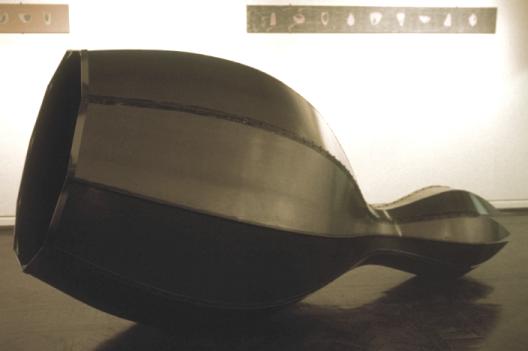
This morning we had a lecture from a sculpture artist who mainly creates her work using steel. The main focus of the majority of her work seems to consist of the differences between light and dark and how different times of day and seasons affect the look of her work. I like the organic, natural nature of her work mixed with the harshness of the made made materials. I think that this creates a nice contrast and allows her work to be separated from other artists. Some of her main influences have been Eva Hesse and Robert Smith. When looking at their work you can instantly see similarities in her work and theirs but i think she has taken her ideas a step forward and created something totally unique. I particularly like her approach to design. She works spontaneously and with very little direction. She sets herself a goal and brief but the actual design process is a very fluid one which takes any direction she sees appropriate to go in. I like to take a similar design approach to my work by giving myself a brief and a deadline but whatever happens in between is undecided and its only when my work starts to take life that i can start to feel how the level with look and what it will contain.

A reoccurring theme that seems to be popping up in the Friday contextual lectures that we have been having is the idea that most of the artists and designers seem to find themselves looping back to the same work after a certain period of time. Because the game industry is still quite young compared to most other design disciplines its hard to analyse whether looping themes would apply to us as game designers, however i feel that it would not. The main reason for this is because i feel technology is advancing so fast that it does not give us the breath to loop back on ourselves and that changes games dramatically. People may argue that its the core of the game that really counts and the same design ideas are still being used now that were used in old arcade games, and this is true to some extent, but i feel now large game companies focus on technology rather than ideas. I see the same ideas being used over and over again being worn thin, so you could also argue the ideas never really go away and come back but rather stay the same and take a different form. Big companies would much rather have a beautiful looking game that sell millions of units with tired and used game designs rather than have a unique and challenging game which would only appear to a select market of gamers and not make as much money. This means that any chance of coming back to core ideas to take a fresh approach years after creating them goes out of the window with multi-million unit selling companies and huge advances in technology.

There are also similarities behind both of our disciplines in the way that we create interactive art work. Joanna likes to create sculptures that people can interact with and walk around experiencing different emotions from different angles rather than if it was stationary. The interactive element of the design definitely interests me more than any others and taking the hands on approach using welding equipment and bolts helps you to connect and appreciate the work more knowing how long they took making the piece. Although there is no real conclusion to make about this blog its a good way to see how Joanna's work flow was used to create such individual and unique pieces and how her work flourishes from the spontaneity that she allows herself.